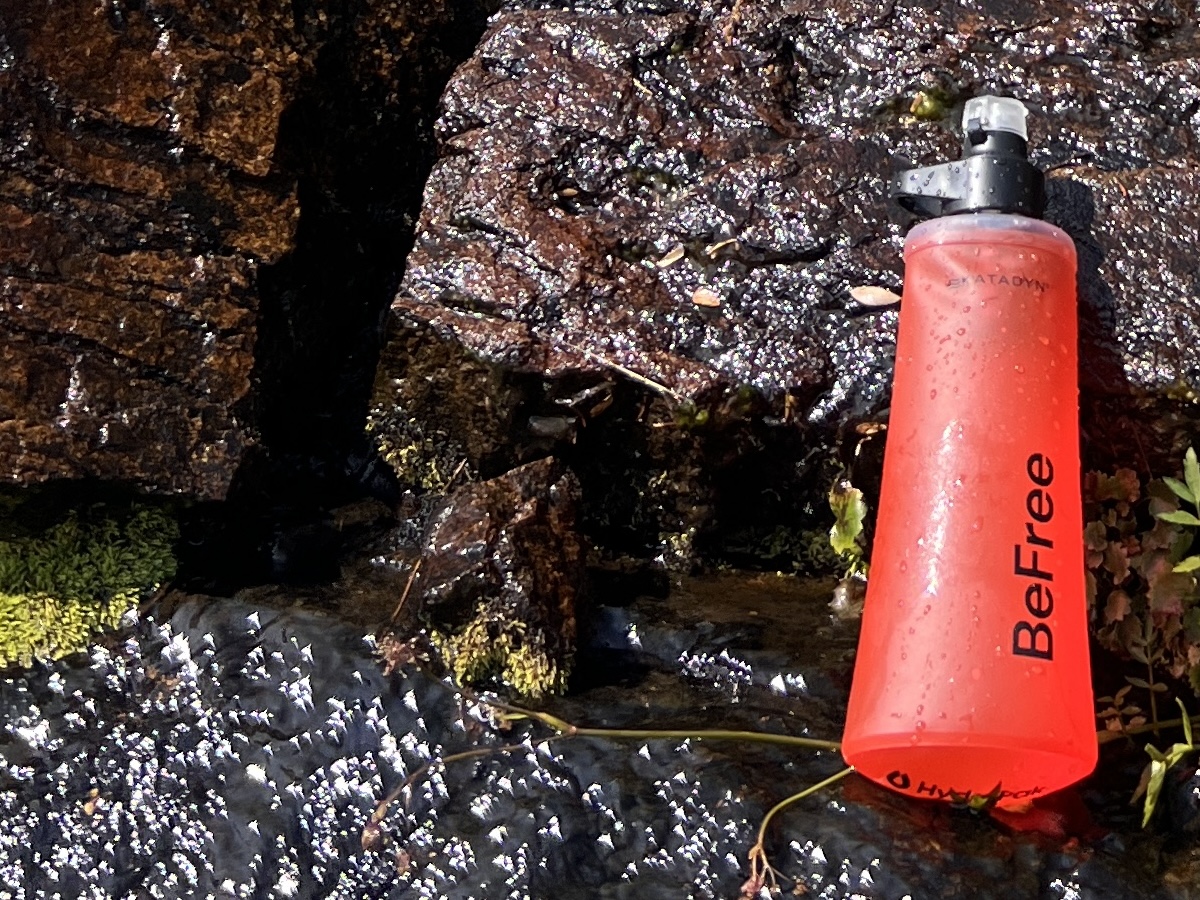
There is only so much water you can carry or will want to carry when hiking. This is why I take the Katadyn BeFree AC 1.0L water filter bottle on most hikes. Using this water filter lightens the load and makes my day easier.
If you hike long days, eventually you must replenish your water supply. If you know your route has reliable water sources, you may not need to start your hike carrying 3+ liters of water in your backpack for the day. Carry what you need to reach your first water source. Filter fresh water along the way, and move all day long with a lighter pack. You instantly experience hiking in a different, more comfortable way.
Before you hit the trails, always research the water source and quality that you intend to draw from. The Katadyn BeFree filters remove bacteria, protozoa, and microplastics. They are not designed to remove heavy metals that can be found in water sources near abandoned mines. Be aware of this issue.
After using the Katadyn BeFree AC 1.0L and Katadyn BeFree AC 0.5L for one year on Colorado hikes and trail runs, I rate the 1.0L version as one of the best water filters for hikers who want easy fill-up, fast flow, simple use, and the ability to carry less water weight.
The Katadyn BeFree AC 1.0L is my top choice for hiking. The Katadyn BeFree AC 0.5L is my pick for trail running and shorter hikes where good water is frequent.
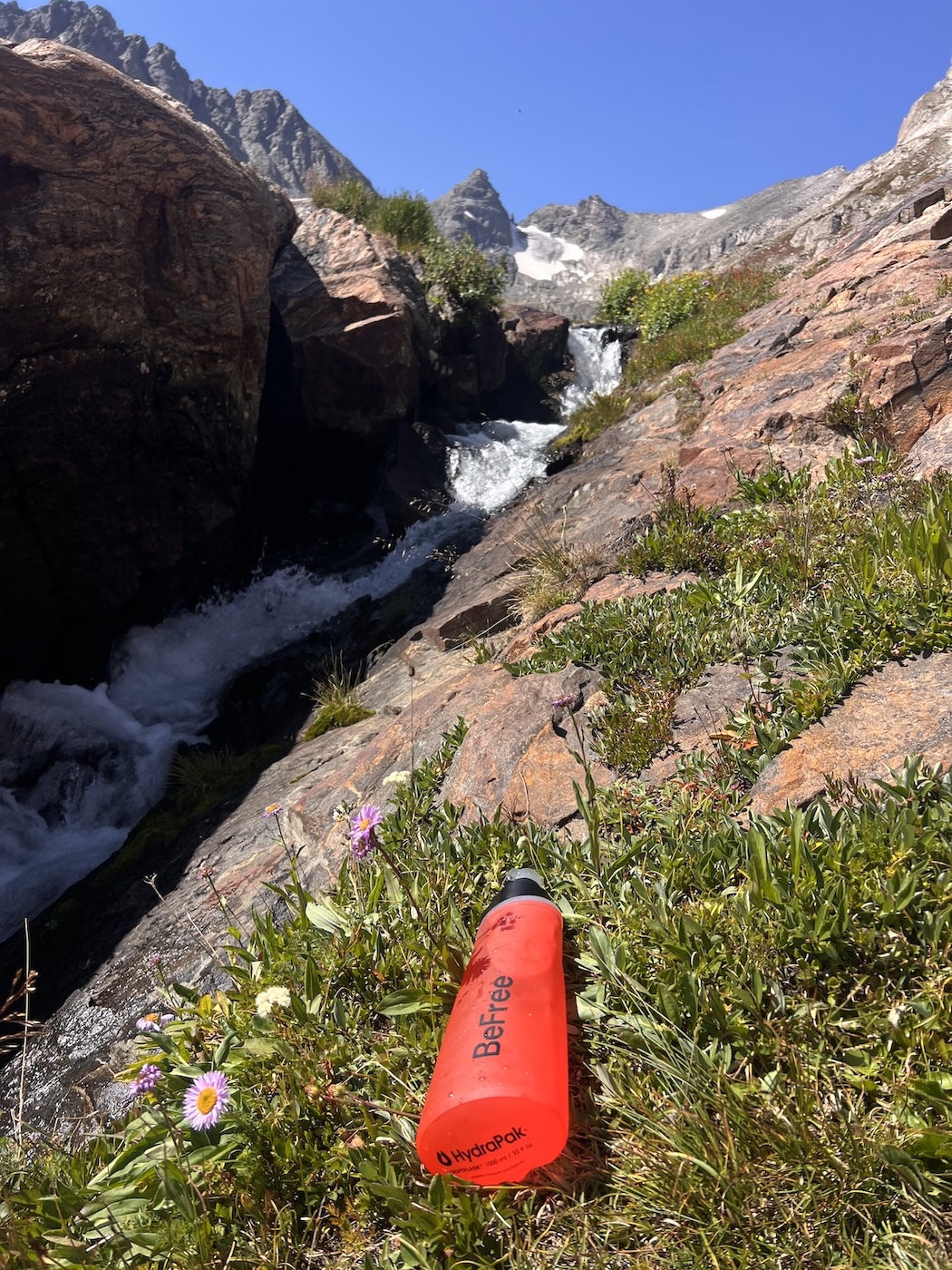
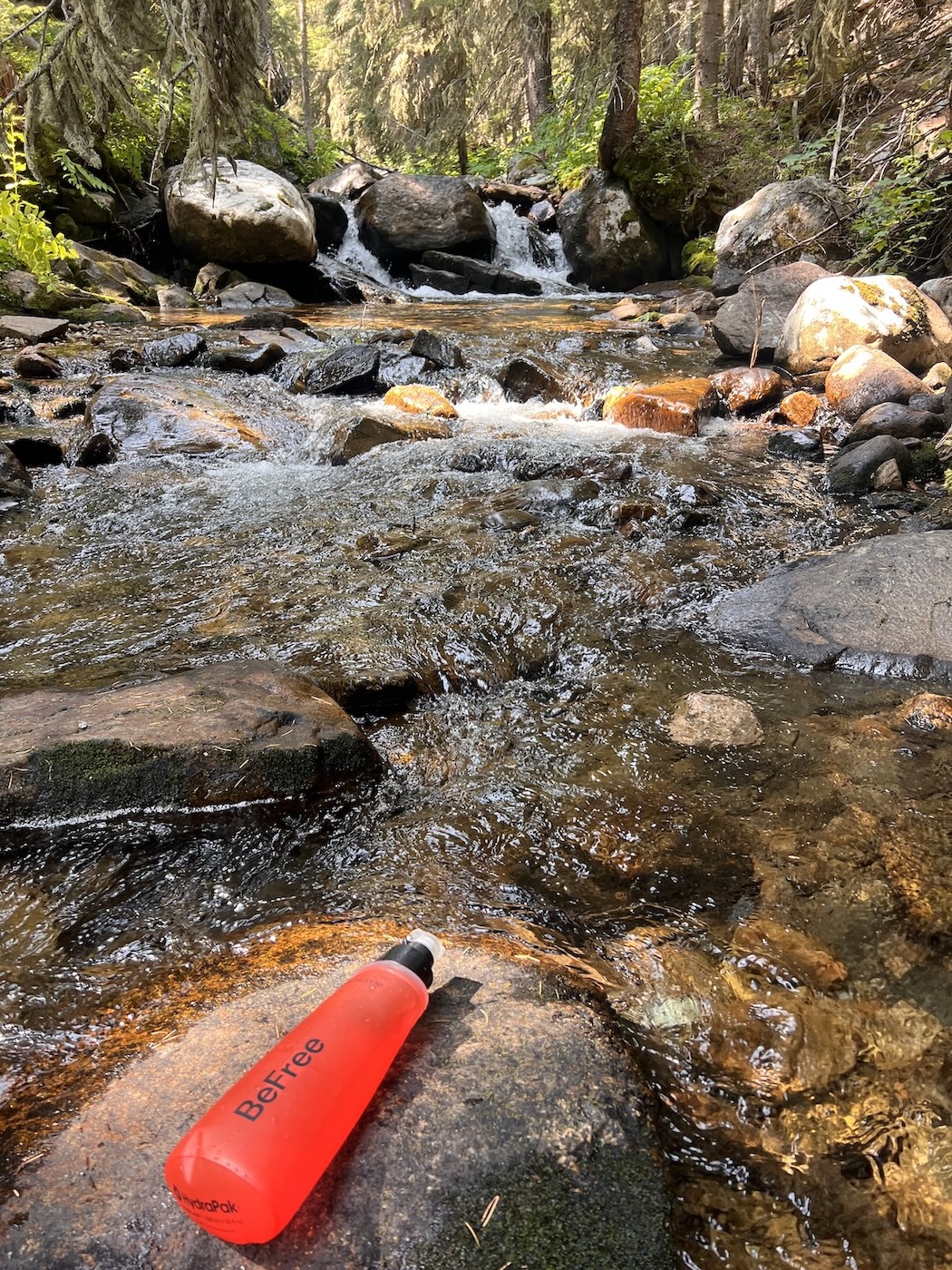
The above photo of my BeFree AC 1.0 liter water filter bottle (double-layer) was taken
Quick Verdict: Is the Katadyn BeFree AC Worth It?
Yes. The Katadyn BeFree AC 1.0L water filter bottle is absolutely worth buying if you hike long days near reliable water sources and want a fast, lightweight, easy-to-use filter that helps you carry less water from the trailhead.
I use my Katadyn water filter bottles on Colorado alpine hikes because I can refill quickly from clear creeks, streams, waterfalls, and snowmelt runoff without using a pump, hose, gravity bag, chemical treatment, or complicated squeeze system.
This product is not just about clean water. The real benefit is the freedom that it offers. Freedom from carrying an excessive amount of water. Freedom to move faster with added mobility. Freedom to drink ice cold, fresh mountain water, which is a delight when you are working hard.
My recommendation: try the Katadyn BeFree AC 1.0L if you mostly hike. Get the Katadyn BeFree AC 0.5L if you are a trail runner. Buy both if you hike and run regularly and want one filter system with two capacity options. Often, I will carry them both because they are so light and pack away small.
The 1.0L is best for long day hikes, Colorado alpine hikes, fast refills from clear streams, solo hikers, fast hikers, and anyone trying to carry less water weight. It is not ideal for group water processing, silty or muddy water, virus protection, large-volume camp filtration, or people who want separate filter and reservoir systems.
Best overall for hiking: Katadyn BeFree AC 1.0L -> Buy at: Backcountry | Amazon
Best for trail running: Katadyn BeFree AC 0.5L -> Buy at: Backcountry | Amazon
Field Testing the Katadyn BeFree AC Water Filter Bottles
Last year I decided to get both sizes of the Katadyn BeFree AC Water Filter Bottles (0.5L and 1.0L) to replace my Platypus QuickDraw, which was somewhat challenging. I wanted a filter that was fast and easy to use. So, I did my research and ended up getting these two water filters.
Thus far, I have taken them with me and put them to the test on seven Colorado hikes and trail runs using a variety of real backcountry water sources. I have used them for one year, filtered water 30+ times, and have not had visible wear, leaking, punctures, or clogging.
I have used the BeFree AC on Sawtooth Mountain, Isabelle Glacier, Huron Peak, Lower and Upper Crater Lakes, Mount Solitude, and Bear Canyon in Boulder. Water sources included creeks, waterfalls, snowmelt runoff, alpine streams, glacier-fed flows, and fast-moving mountain water.
I tested the 0.5L and 1.0L on long 10+ mile hikes. As I went further on my adventures, more water became a requirement.
Real-World Speed Test: Stream Water to Drinking Water in 15 Seconds
The fastest way to understand why I like this filter is to see it in action.
In the field video below, I collected water from a clear Colorado stream with the Katadyn BeFree AC 1.0L water filter, screwed the filter cap back on, and started drinking in 15 seconds.
This is why I like this water filter. So simple.
There is no pump to assemble. No hose. No separate dirty-water bag. No gravity setup. No chemical wait time. No complicated backflush process in the field.
You simply unscrew the filter cap, fill the soft flask, screw the cap back on, squeeze, and drink.
That speed matters because filtering water does not feel like a separate chore. It becomes part of the rhythm of the hike.
My Conclusion After One Year
The Katadyn BeFree AC water filter bottle is one of the most useful pieces of hiking gear I own because it changes how I plan, carry, and consume water.
Before using this water filter bottle, I had to carry a lot of water from the trailhead. That works, but water is heavy. One liter weighs about 2.2 pounds. Three liters is roughly 6.6 pounds before you even count the bottle or reservoir.
Now, if I know the route has reliable water, I can start and hike lighter throughout the day. I also end up drinking my real water requirements, which is good for energy and helps me avoid dehydration. In the past, I would finish hikes super thirsty. Now, I finish feeling great.
These days, I hike light with my Osprey Duro 6 trail running hydration vest, a 1.5L water reservoir inside it, sometimes an extra soft flask, a small waist pack, and the BeFree AC water filter. This setup lets me be mobile, move quickly, and refill when the route offers clean, fast-moving water.
Field Test Scores:
- Ease of use is 10/10
- Flow speed is 9.5/10
- Hiking practicality is 9.5/10
- Trail running practicality is 9/10
- Packability is 9/10
- Taste is 9/10
- Durability is 8/10
- Dirty water performance is 7/10
- Overall value is 9.5/10
The Katadyn BeFree AC 1.0L water filter bottle is a fast, simple, field-proven water filter bottle that I trust for long Colorado day hikes when reliable water sources let me carry less water and refill on the move.
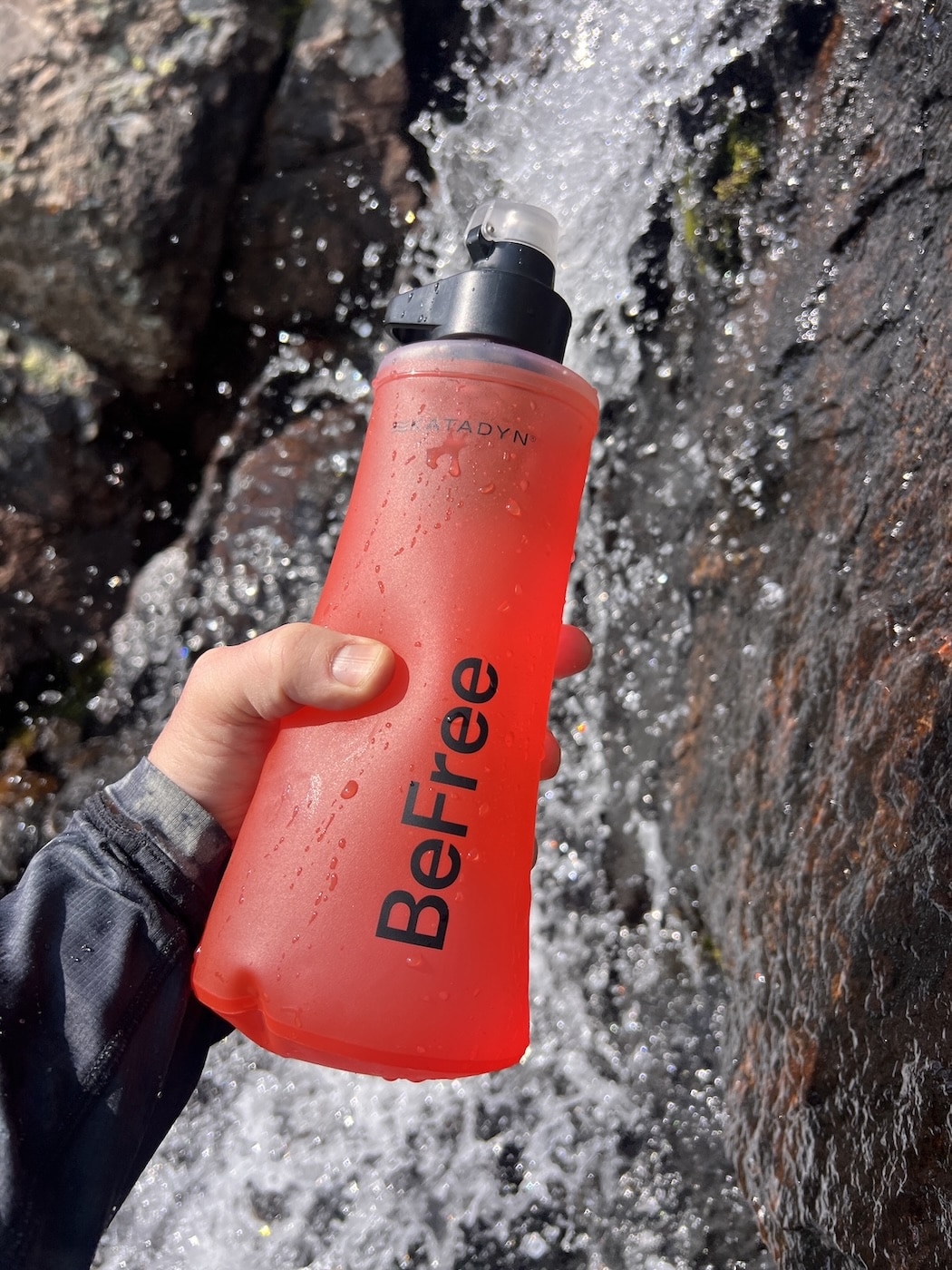
What Is the Katadyn BeFree AC 1.0L Water Filter Bottle?
The Katadyn BeFree AC 1.0L is a soft-flask water filter bottle with a built-in filter cap. You fill the soft bottle from a water source, screw the filter cap back on, and drink directly through the mouthpiece.
It is a simple and easy-to-use product, which is why I like it.
The system has three main parts: the soft flask, the filter cap with hollow fiber membrane, and the activated carbon element. The 1.0L version uses a double-layer HydraPak SoftFlask made from TPU. Katadyn lists it as PVC and BPA free, and positions the 1.0L double-layer flask for harsher conditions. That lines up with how I use it on rocky Colorado alpine hikes.
The BeFree AC 1.0L has a 1.0L capacity, a hollow fiber EZ-Clean Membrane, a 0.1 micron pore size, and is listed as effective against protozoa, bacteria, and microplastics. The filter capacity is up to 1,000 liters depending on water quality. The activated carbon is replaceable and is intended to improve taste while reducing odor, turbidity, and chlorine. Katadyn lists carbon life up to 200 liters depending on water quality, output up to 2 liters per minute, weight at 85 grams, dimensions at 273 x 107 x 78 mm, and a 42 mm thread.
“AC” stands for activated carbon. The regular filtration comes from the hollow fiber membrane. The activated carbon pad is used to improve taste and reduce odor, turbidity, and chlorine. That matters most with treated tap water, lake water, still water, or any source that smells or tastes off.
When I filter cold, clear Colorado alpine water from a fast-moving stream, I rarely use the carbon pad. That water already tastes amazing. But the carbon feature is useful when taste or smell is a concern.
Verified Katadyn BeFree AC 1.0L Water Filter Bottle Specifications
| Spec | Katadyn BeFree AC 1.0L |
|---|---|
| Capacity | 1.0L |
| Filter type | Hollow fiber EZ-Clean Membrane |
| Pore size | 0.1 micron |
| Effective against | Protozoa, bacteria, microplastics |
| Filter life | Up to 1,000 liters depending on water quality |
| Activated carbon | Replaceable |
| Carbon effect | Improves taste; reduces odor, turbidity, and chlorine |
| Carbon life | Up to 200 liters depending on water quality |
| Output | Up to 2 L/min |
| Weight | 85 g |
| Dimensions | 273 x 107 x 78 mm |
| Soft flask | HydraPak TPU SoftFlask, PVC/BPA free |
| Thread | 42 mm |
See the BeFree AC 1.0L fact sheet.
Why I Bought the Katadyn BeFree AC Water Filters?
I bought the Katadyn BeFree AC 1.0L and 0.5L water filter bottles to replace my Platypus QuickDraw setup.
My experience with the Platypus QuickDraw was unsuccessful. The filter would not pass water when I tried to use it. Although it had been sitting unused for a year or two after purchase, I was surprised when it did not function. The important takeaway is that I never actually used the Platypus QuickDraw for so long. Somehow, it just seemed more complicated than I desired mid-hike.
The Katadyn BeFree AC water filters never feel complicated.
The smaller connection point also made the Platypus system harder to fill compared to the BeFree bottles. The connection felt more cumbersome, and the included pouch was stiffer than the BeFree soft flask. I also had a pouch fail and leak after fewer than 20 uses as a bottle in a backpack.
That experience pushed me toward a water filter that was simpler. I wanted fast filling, fast drinking, fewer pieces, soft flask design, easy field use, a wide mouth, low weight, and something I would actually want to use often.
The BeFree AC was the solution for me. I bought both sizes because they serve different purposes. The 1.0L is better for hiking. The 0.5L is better for trail running since the shape fits most running vests.
| Katadyn BeFree AC is best for… | Not ideal for… |
|---|---|
| Long day hikes | Group water processing |
| Colorado alpine hikes | Silty or muddy water |
| Fast refills from clear streams | Virus protection |
| Solo hikers and fast hikers | Large-volume camp filtration |
| Carrying less water weight | People who want separate filter/reservoir systems |
| Refilling reservoirs or drinking directly | Maximum hard-bottle durability |
The Real Benefit: Carrying Less Water Weight
Less is huge. There is only so much water you can carry, or will want to carry.
That is the real reason this product matters. If I carry less water, I burn my energy more slowly.
If you are hiking 10, 15, 20, or more miles in Colorado, carrying all your water from the trailhead can be heavy. Sometimes it is necessary. Sometimes it is smart. But sometimes it is just extra weight because the route has reliable water sources.
When I know I have water on the route, I can carry what I need to reach that source instead of loading up with every liter I might drink that day.
That is liberating.
A water filter lets me move all day with a lighter setup. On some hikes, that means I do not need to carry 3+ liters from the start. I can carry enough water to safely reach the next source, then refill from creeks, streams, waterfalls, or snowmelt runoff.
My normal system and water game plan is simple. I start with a full 1.5L water reservoir in my Osprey Duro 6 vest. I carry the Katadyn BeFree AC 1.0L for refills and direct drinking. I may add an extra 0.5L soft flask if the first water source is far into the hike. I use the BeFree water filters to refill my reservoir when it gets low. And I drink directly from the BeFree when I find especially cold, clear, enticing water.
This setup lets me be nimble on my feet. I can hike or run most of the day without feeling overloaded.
On long hikes, water weight affects how fast you move, how your shoulders and back feel, how hot you get, how tired you feel late in the day, and how much freedom you have to move efficiently, nimble, and quick.
The BeFree AC water filter bottles help most when the route has dependable water. If a hike has a creek running parallel to the trail, or reliable snowmelt crossing the route, the filter becomes a pack-weight reduction tool.
That is the point.
Not just “this filters water.”
It helps me carry less water. I can clearly remember the first 14er I hiked in Colorado while carrying too much weight, including snacks, water, and gear. Quickly, I regretted my choices. Now, I take the bare minimum that makes sense.
My Water-Source Planning Method
Before a long hike or trail run, I look at maps for water sources. This is now part of my pre-hike planning checklist.
I look for creeks along the route, stream crossings, lakes, waterfalls, snowmelt runoff, seasonal water reports, distance to the first reliable water source, distance between refill points, and backup water options nearby.
Then I decide how much water to carry from the start of the hike.
If the first reliable water source is far away, I carry more. If water is frequent and dependable, I can start lighter.
That is how this filter becomes useful. It is not a replacement for planning. It rewards good planning.
Where I Tested the BeFree AC in Colorado
I used the BeFree AC 1.0L on a variety of high country hikes in Colorado during summer and fall. These were challenging day hikes with real mileage, elevation gain, and high-alpine terrain.
Most of the hikes were greater than 10 miles and had more than 2,000 feet of vertical gain. Trailheads and starting points were often above 9,000 feet.
On Sawtooth Mountain, I hiked about 20 miles with 4,100 feet of gain and filtered water from Middle Saint Vrain Creek. The long approach had water along much of the route, which made the BeFree especially useful.
On the Isabelle Glacier hike via Long Lake and Lake Isabelle, I filtered from South Saint Vrain Creek. This is a perfect example of a high alpine route where a fast filter makes sense because water is available along the approach.
On Huron Peak, I filtered snowmelt runoff to South Fork Clear Creek. On Lower and Upper Crater Lakes in the Indian Peaks, I filtered from South Boulder Creek and the falls between the lakes. I also used it around Mount Solitude and Bear Canyon in Boulder.
My favorite use case is cold, clear, moving water in the high alpine. I filter from creeks, alpine streams, snowmelt runoff, glacier-fed streams, waterfalls, and fast-moving mountain water. That is where the BeFree AC shines.
I love using this filter in the Colorado high country where the water is ice cold and crystal clear. It feels amazing to stop at a stream, fill the bottle, and drink cold water almost immediately.
What Water Sources I Avoid
A water filter does not mean you should choose the worst possible water source. The best clogging strategy is prevention.
I avoid poor water sources when better options are available. That includes silty water, muddy water, stagnant water, debris-heavy water, immediate glacier runoff if it looks loaded with sediment, water with obvious contamination risk, and water near heavy livestock or human impact.
I look for clear, fast-moving water whenever possible.
Cold, clear mountain water is not automatically safe. It can look perfect and still contain microorganisms. That is why I filter it. Some people I know do not bother. But this filter is so easy, I would rather avoid any potential health issues.
The point is not that alpine water does not need treatment. The point is that clear, moving alpine water is usually a better source for this kind of filter than silty, stagnant, debris-heavy water.
How Easy Is the Katadyn BeFree AC Water Filter to Use?
What I appreciate most about the Katadyn BeFree AC is that it could not be easier to use.
It is barely different from using a regular water bottle. If you can fill a bottle and screw on a cap, you can use this filter. There is no learning curve.
You unscrew the cap from the soft flask, fill the flask with water, screw the filter cap back on, and drink.
That is it.
In ideal conditions, it is extremely fast. Unscrewing the cap takes a couple seconds. Filling the bottle takes a few seconds depending on the water source. Screwing the cap back on takes a few more seconds. Then you drink immediately.
In one field video, I collected stream water and started drinking in 15 seconds. In another, I was quenching my thirst in about 20 seconds. Even when I am not rushing, it does not take long.
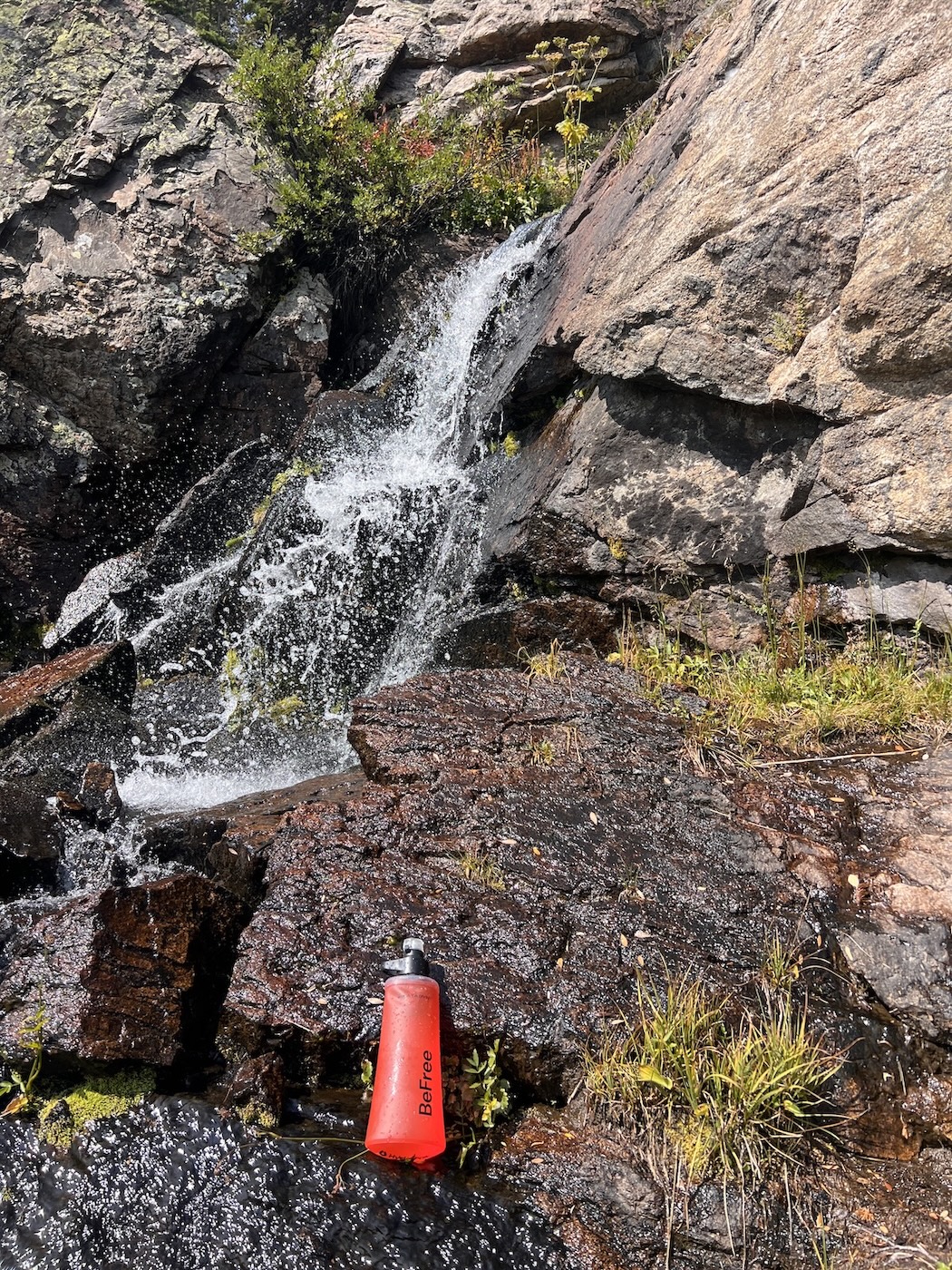
The wide opening is a big advantage. This matters more than people might think. A narrow pouch or small opening can be annoying when you are trying to fill from a shallow creek, small waterfall, or awkward stream bank. The BeFree bottle is easy to scoop and fill from fast-flowing or slow-flowing water.
I filled it from waterfalls, streams, and creeks without any hassle. That is one of the reasons I prefer it to the Platypus QuickDraw system I tried.
I usually drink directly from the soft flask. That is the fastest and simplest use. But the 1.0L version is also useful for refilling hydration reservoirs, extra water bottles, soft flasks, cooking containers at camp, or a dog’s water.
For hiking, this is one reason I prefer the 1.0L over the 0.5L. The bigger bottle is more useful as both a drinking bottle and a refill tool. It is also made of thicker and more durable rubber.
Flow Rate and Real-World Speed
Katadyn lists the BeFree AC output at up to 2 liters per minute. In actual use, it feels very fast.
I did a simple clean-water test by filling each bottle and squeezing it empty. The BeFree AC 0.5L emptied in 7.0 seconds. The BeFree AC 1.0L emptied in 12.5 seconds.
That is fast.
The important point is not just the lab-style number. The important point is how it feels during a hike.
It feels instant.
In the field, the whole process depends on water source access. If I have easy access and good footing, I can approach the source, unscrew the cap, fill the bottle, screw the cap back on, and start drinking in well under 30 seconds.
My fastest video shows stream water to drinking water in 15 seconds.
That is the kind of speed I want on a long hike. Fill. Drink. And, go.
Several things affect real-world speed: water depth, water flow, footing, how full you fill the flask, how hard you squeeze, water clarity, filter age, whether the filter is wet and flowing well, and whether the filter needs cleaning. The one I have used most is about 5–10% slower now, but it speeds up with cleaning.
Even with those variables, this is one of the fastest and easiest filters I have used.
Taste Test: Is the Activated Carbon Worth It?
The activated carbon feature is useful, but I do not always need it.
When I am filtering cold, clear Colorado alpine water from fast-moving streams, the water already tastes great. It is rare that I use the carbon pad because there is no bad taste or smell to correct.
That said, I did test it at home.
The tap water in Boulder has a slight processed smell from treatment. It does not taste terrible, but it does not taste amazing. At home, I use a Berkey water filter system.
When I used the Katadyn BeFree AC carbon pad to filter Boulder tap water, the smell was removed and the water tasted similar to the Berkey output. I rate the activated carbon as effective.
I would use the activated carbon feature for lake water, still water, water with odor, water with off taste, treated tap water, travel water, or any source where smell and taste confidence matters.
I usually skip it for cold clear streams, fast-moving creeks, fresh snowmelt water, clean waterfall flow, and alpine sources that already smell and taste fresh.
Activated carbon is useful, but it is not the same thing as virus purification. This is still a filter bottle, not a full purifier.
Durability: How the BeFree 1.0L Double-Layer Soft Flask Holds Up
The 1.0L BeFree AC water filter has a double-layer soft flask. That matters to me.
I hike in Colorado. A lot of the terrain is rocky. Above treeline, rock can be much sharper than it looks. Granite, talus, and broken rock can be rough on soft bottles, reservoirs, and bladders.
I have had enough hydration gear over the years to know that soft containers require care.
The 1.0L BeFree AC feels thicker and more durable than the much lighter, almost paper-like feel of the 0.5L. I like that for long alpine hikes. Katadyn’s fact sheet specifically lists the 1.0L version as having a Double-Layer SoftFlask for harshest conditions.
After roughly 30+ fills, I have experienced no visible wear, leaking, punctures, cap problems, handle issues, rubber taste, plastic taste, silicone taste, filter clogs, or reason to doubt it yet.
The handle feels strong and comfortable. The bottle is easy to carry by hand. I can also stash it in a pack, waist pack, or vest pocket depending on what I am doing. This water filter unexpectedly became a favorite hiking gear item of mine.
This is still a soft flask. I would not rest it on rocks or rough surfaces, store it next to sharp gear, cookware, knives, or any kind of abrasive objects. A soft flask is durable until you abuse it. I handle it with care, and so far it has held up well.
The handle is one of the better design features. It gives you a secure way to carry the bottle or hang it on a pack. Katadyn also notes that the flip cap seals tightly and that the silicone mouthpiece can be removed for cleaning or replacement. Those are small details, but they matter for long-term use.
Packability and Carry Comfort
The BeFree AC is easy to carry because it is soft and packable.
When full, it carries like a soft water bottle. When empty, it rolls down and takes up very little space. My 1.0L packs down to about 5 x 3.5 inches. My 0.5L packs down to about 4.5 x 3.5 inches. The 1.0L is not tiny, but it is totally acceptable when empty and rolled up. The 0.5L is slightly more compact and easier to stash, although the cap size is identical to the 1.0L.
When hiking, I carry the 1.0L by the handle, in a backpack pocket, in a running vest pocket if space allows, inside my waist pack full or empty, or stashed in the pack when empty.
For hiking, the 1.0L size works very well. For trail running, it is not my first choice.
The 1.0L BeFree AC will not fit well in most front running vest pockets since it is wider at the bottom than the top. This makes it difficult to slide into a vertical-shaped pocket unless the pocket is generous in size.
The 0.5L version is much better for trail running, and the shape is intended to be compatible with trail running vests.
The BeFree AC 0.5L fits snugly in the front pocket of my Osprey Duro 6 running vest. It is a tight squeeze because the Duro 6 front pockets are flat, but it still works. I hold the top of the water bottle and cap with an elastic loop on my vest, and it all stays in place while I hike or run.
The 0.5L probably fits even better in other vests with larger front pockets.
Katadyn BeFree AC 1.0L vs 0.5L: Which Size Should You Buy?
This is the easiest way to make the decision.
Buy the 1.0L if you mainly hike. Buy the 0.5L if you mainly trail run. Buy both if you regularly do both.
I am happy that I bought both because they have different use cases.
The 1.0L is better for hiking because it gives you more water per fill. This can help on long hikes or when there is greater distance between water sources. It also has the double-layer soft flask, which I prefer in rocky alpine terrain. I do not mind the extra weight because I have the carrying capacity, and I am usually hiking rather than running when I bring the 1.0L.
For long day hikes, the 1.0L is the clear winner.
The 0.5L is better for trail running because it is smaller, lighter, narrower, and easier to fit in a vest pocket. I use this water filter bottle for trail runs, shorter hikes, and hikes where I know I will follow a consistent water source.
The downside is that you need to refill more often. That is fine when water is frequent. It is less ideal when water sources are far apart. This is why I often carry my 1.5L water bladder too, so I have enough water for a few hours, but it is not too heavy or overbearing.
Because both versions use a similar filter cap system, owning both gives me one water filtration system with two capacity options. I can choose the flask based on the route, or if I am running for a stretch, or hiking. Covering all situations is ideal.
Cleaning, Maintenance, Clogging, and Slow Flow
Cleaning the Katadyn BeFree AC is easy. That is another advantage. Katadyn says the EZ-Clean Membrane can be cleaned by shaking or swishing, with no back-flushing or tools required. I can confirm this is true.
If flow slows in the field, the basic method is to fill with clean water, shake up and down, swish side to side, squeeze and empty the water, then repeat if required. The cleaning directions are printed on the side of the soft flask.
After an outdoor adventure, I keep it simple. I rinse the parts under my kitchen faucet, separate the filter cap and soft flask, lay everything out on a towel to air dry thoroughly, screw the parts together once dry, and store for the next hike.
For long-term storage, dry everything completely, do not store it wet and sealed, protect the filter element, keep it away from sharp objects, and avoid freezing the filter if it is wet.
I clean my BeFree water filters after each use. That is the habit I recommend to extend the lifespan of the product and get the most value.
My BeFree AC has not clogged. But I also do not abuse it. I am careful and sensible with its use. I avoid silty water, debris-heavy water, and choose clear, moving water whenever possible. I rinse and dry the filter after trips. This is probably why I have not had flow problems yet.
Slow flow can happen from sediment, silt, algae, debris, poor cleaning, filter age, poor water source selection, a dry or poorly wetted filter, or repeated use in bad water. If flow slows or halts completely, shake and swish the filter, use cleaner water if possible, avoid forcing silty water through it, clean it after all hikes, and replace the filter when it reaches the end of its useful life.
The BeFree AC is easy to clean, but cleaning is not a miracle. If you constantly filter bad water, you should expect the filter to work harder and slow down faster.
What the Katadyn BeFree AC Does and Does Not Protect Against
This is important to know. The Katadyn BeFree AC is a filter bottle, not a water purifier.
Katadyn lists the hollow fiber filter as effective against protozoa, bacteria, and microplastics. The activated carbon helps with taste, odor, turbidity, and chlorine.
Do not buy the Katadyn BeFree water filters expecting them to solve every water problem. They are not designed for virus protection, heavily contaminated water, unknown urban or disaster water, chemical contamination beyond the stated carbon benefits, unsafe source selection, or replacing good judgment.
If you need virus protection, you need a purifier, such as a UV purifier or another appropriate treatment method.
Field Test Results and Data
| Test | Result |
|---|---|
| Fastest real-world stream-to-drink test | 15 seconds |
| BeFree AC 0.5L clean-water empty test | 7.0 seconds |
| BeFree AC 1.0L clean-water empty test | 12.5 seconds |
| Field use | 7 Colorado hikes and trail runs |
| Approximate use | 30+ fills |
| Wear/leaking/clogging | None so far |
| Packed size, 1.0L | About 5 x 3.5 inches |
| Packed size, 0.5L | About 4.5 x 3.5 inches |
| Carbon test | Improved Boulder tap water taste and odor |
Pros and Cons After Field Testing
Pros
- Extremely easy to use
- Stream water to drinking water in 15 seconds in my field video
- Fast flow rate
- Wide mouth makes it easy to fill
- 1.0L capacity is useful for hiking
- Double-layer 1.0L flask is better for rocky terrain
- Lightweight at 85 g
- Packs small when empty
- No rubber-like taste in my testing
- Activated carbon improves taste and odor if needed
- Simple design
- Good handle
- Easy to clean with no back-flushing tools required
- Helps reduce carried water weight on hikes
- Excellent for clear alpine and mountain water sources
- Works well for direct drinking or refilling a larger reservoir
Cons
- 1.0L is not ideal for front running vest pockets
- 0.5L is better for trail running but has less capacity
- Double-layer flask is not available on the 0.5L
- Soft flask still requires care around sharp rocks and gear
- Not ideal for silty water
- Not a purifier
- Not the best system for large groups
- Requires water-source planning if you want to carry less water
- Replacement carbon and filter parts add long-term extra cost
Katadyn BeFree AC vs Platypus QuickDraw
The Platypus QuickDraw is the main comparison I can speak to from direct experience.
My experience with the QuickDraw was not good. The filter component would not pass water on first attempted use, though it had been sitting unused for a year or two after purchase. I also found the smaller connection point harder to fill. The system felt more cumbersome than the BeFree AC. The included pouch was stiffer, and a pouch failed and started leaking after fewer than 20 uses as a bottle in a backpack.
The BeFree AC was much better for me.
I prefer the BeFree AC because it is easier to fill, easier to drink from, softer in the hand, faster in real use, simpler on the trail, better for direct drinking, and better for my hiking and trail-running system.
This is based on my personal experience with the QuickDraw, not a complete lab test of every Platypus QuickDraw unit. But that experience did influence my buying decision. After a year of using the BeFree AC, I have no regrets.
How the BeFree AC Compares to Other Water Filters
I have not personally field-tested every popular water filter head-to-head, so I am not going to pretend this is a full lab comparison.
From a design and use-case standpoint, choose a BeFree AC water filter if you want fast direct drinking, simple use, soft-flask carry, high alpine hiking, frequent refills, lightweight solo use, and a filter that fits naturally into hiking pace.
Choose another system if you need group water volume, purifier-level protection, maximum hard-bottle durability, camp water processing, or better performance in silty water.
That is where the BeFree AC fits best. It is not the most universal water treatment system for every backcountry scenario. It is a fast, simple, lightweight filter bottle that is excellent when you are moving through terrain with reliable water sources.
Who Should Buy the Katadyn BeFree AC 1.0L?
Buy the Katadyn BeFree AC 1.0L if you are a hiker who wants fast, easy access to filtered water and you often hike where water is available.
It is especially good for day hikers, long-distance day hikers, Colorado hikers, mountain hikers, high-alpine hikers, solo hikers, fast hikers, thirsty hikers, hikers using hydration vests, hikers who plan around water sources, hikers who want to carry less water, and hikers who dislike pumps and complicated systems.
The Katadyn BeFree AC 1.0L water filter bottle is ideal for 10–20+ mile day hikes, hikes with creeks along the route, alpine basin hikes, waterfall routes, snowmelt-fed trails, hot exposed hikes with known refill points, and routes where carrying 3+ liters from the start is unnecessary.
For me, the Katadyn BeFree AC 1.0L is the perfect water filter for hiking.
Who Should Buy the Katadyn BeFree AC 0.5L Instead?
The Katadyn BeFree AC 0.5L is the better choice if you mainly trail run or want the most compact otpion.
I use this water filter bottle for local Boulder and Front Range hikes and trail runs, trails with frequent water sources, and trail runs where compact carry matters more than capacity.
The 0.5L is easier to fit in a running vest pocket. It is lighter and slimmer. It is a better match for fast movement.
But it has half the capacity, so you need to refill more often. That is why I prefer the 1.0L for hiking.
The 0.5L is not worse than the 1.0L. It is just built for a different job due to the size, shape, and lighter design. You can see in the photo of my Katadyn BeFree AC 0.5L water filter that the soft bottle is narrower and tapered so you can slide it into a pocket easily. The Katadyn BeFree AC 1.0L is tapered in the opposite direction (narrow at top, wider at base) as you can see in my photos above.

1.0L vs 0.5L Comparison and Specifications
| Feature | BeFree AC 1.0L | BeFree AC 0.5L Slate Blue |
|---|---|---|
| Best use | Hiking, long day hikes, alpine routes | Trail running, short hikes, fast local routes |
| Capacity | 1.0L | 0.5L |
| Weight | 85 g | 72 g |
| Dimensions | 273 x 107 x 78 mm | 273 x 85 x 54 mm |
| Flask design | Double-layer SoftFlask | Ultra-slim single-layer SoftFlask |
| Durability advantage | Better | Good, but lighter |
| Vest-pocket fit | Less ideal | Better |
| Refill frequency | Lower | Higher |
| My use | 10–20+ mile Colorado hikes | Boulder and high-alpine trail runs, shorter hikes |
| My recommendation | Best for hikers | Best for trail runners |
Who Should Not Buy the Katadyn BeFree AC?
The BeFree AC is excellent for the right use case, but it is not for everyone.
Skip it if you need group capacity. If you are filtering water for a group at camp, a gravity filter or pump system may be better. The BeFree AC is great for solo use and fast refills, but it is not my first choice for processing large volumes of water for multiple people.
Avoid it if you need virus protection. This is a filter, not a purifier. If you need virus protection, look at a purifier or combine filtration with another treatment method.
If you want maximum durability this would not be the best choice. Soft flasks are convenient, light, and packable, but they are not as durable as hard bottles.
If you do not want to research and plan water sources than a water filter may not be for you. The BeFree AC becomes most powerful when you plan around water. If you do not want to research water sources, carry more water or choose a system that matches your hiking style better.
Value: Is the Katadyn BeFree AC Worth $59.95?
Yes. I paid $59.95, and after using it regularly, it already feels like an excellent value.
At first, my 1.0L filter bottle cost about $10 per outing. Based on how much I plan to use it, that will drop below $2 per outing and continue going lower over time.
That is near-zero cost compared with the benefits.
The value is not just the filter. The value is carrying less water, saving energy, accessing cold water on long hot days, moving faster, reducing overall pack weight, drinking fresh mountain water, having a simple tool that actually gets used, and making long hikes more comfortable.
A piece of gear is valuable when it changes your experience in a meaningful way. These water filters do.
It is not a great value if you rarely hike near water, mostly hike dry desert routes, need group filtration, need virus purification, do not maintain your gear, prefer hard bottles, or do not want to plan refill points.
But for my style of hiking in Colorado, these water filters are absolutely worth it.
Final Verdict: Should You Buy the Katadyn BeFree AC?
Yes. I would buy it again with no hesitation. I would buy this as a gift for a hiker. I think the product is that great.
For hiking, I recommend the Katadyn BeFree AC 1.0L because the capacity and double-layer flask make it more useful on long, rocky Colorado alpine routes.
For trail running, I recommend the Katadyn BeFree AC 0.5L because it is lighter, slimmer, and easier to carry in a vest pocket.
If you hike and trail run regularly, buying both could make sense. They are different tools for different days.
The Katadyn BeFree AC water filter bottles are super easy to use, fast enough to drink from a stream in seconds, durable in the 1.0L double-layer version, and ideal for hikers and trail runners who plan routes around reliable water sources.
This is one of those products that quickly feels like it costs almost nothing because it solves a real problem every time you use it.
For me, the BeFree AC is not just a water filter.
It is a lighter pack, fast refills, colder drink, and better long-hike strategy.
Katadyn BeFree AC Water Filter Bottle FAQs
Is the Katadyn BeFree AC worth it?
Yes. The Katadyn BeFree AC is worth it if you hike or trail run near reliable water sources and want a fast, lightweight filter that lets you carry less water from the start.
Is the Katadyn BeFree AC 1.0L good for hiking?
Yes. The 1.0L version is the best choice for most hikers because it has more capacity and a double-layer soft flask that is better for rocky alpine terrain.
Is the Katadyn BeFree AC 0.5L good for trail running?
Yes. The 0.5L version is better for trail running because it is lighter, slimmer, and easier to fit into a running vest pocket.
What is the difference between the Katadyn BeFree AC 1.0L and 0.5L?
The 1.0L has more capacity and a double-layer soft flask. The 0.5L is lighter, narrower, and better for vest-pocket carry. I use the 1.0L for hiking and the 0.5L for trail running.
How fast does the Katadyn BeFree AC filter water?
Katadyn lists the output at up to 2 liters per minute. In my clean-water test, the 0.5L emptied in 7.0 seconds and the 1.0L emptied in 12.5 seconds with squeezing.
Can you really drink from it in under 20 seconds?
Yes. In my field video, I collected clear stream water with the BeFree AC 1.0L and started drinking in 15 seconds.
Does the Katadyn BeFree AC remove viruses?
No. The BeFree AC is a filter, not a purifier. Katadyn lists it as effective against protozoa, bacteria, and microplastics.
Does the activated carbon make a difference?
Yes. In my Boulder tap water test, the activated carbon removed the treated-water smell and improved the taste. Katadyn says the carbon improves taste and reduces odor, turbidity, and chlorine.
Does the water taste like rubber?
No. In my testing, the filtered water did not taste like rubber.
Does the Katadyn BeFree AC clog?
Mine has not clogged, but I avoid silty and debris-heavy water. Clear, moving water is the best source choice.
How do you clean the Katadyn BeFree AC?
Shake or swish the EZ-Clean Membrane in clean water in the field. After a trip, rinse the parts and let them air dry thoroughly before storage.
Can you backflush the Katadyn BeFree AC?
It is designed for shake-and-swish cleaning, not tool-based backflushing.
How long does the Katadyn BeFree AC filter last?
Katadyn lists the hollow fiber filter capacity at up to 1,000 liters depending on water quality. The activated carbon capacity is up to 200 liters depending on water quality.
Can you replace the activated carbon?
Yes. Katadyn lists the activated carbon as replaceable.
Can you use the Katadyn BeFree AC to fill a hydration reservoir?
Yes. I use the 1.0L version to drink directly and to refill my Osprey Duro 6 hydration reservoir.
Is the 1.0L too big for a running vest?
For most front vest pockets, yes. The 0.5L version is better for trail running and vest-pocket carry.
Is the Katadyn BeFree AC better than the Platypus QuickDraw?
For my use, yes. The BeFree AC has been easier to fill, easier to drink from, faster in practice, and more reliable than my personal experience with the Platypus QuickDraw.