
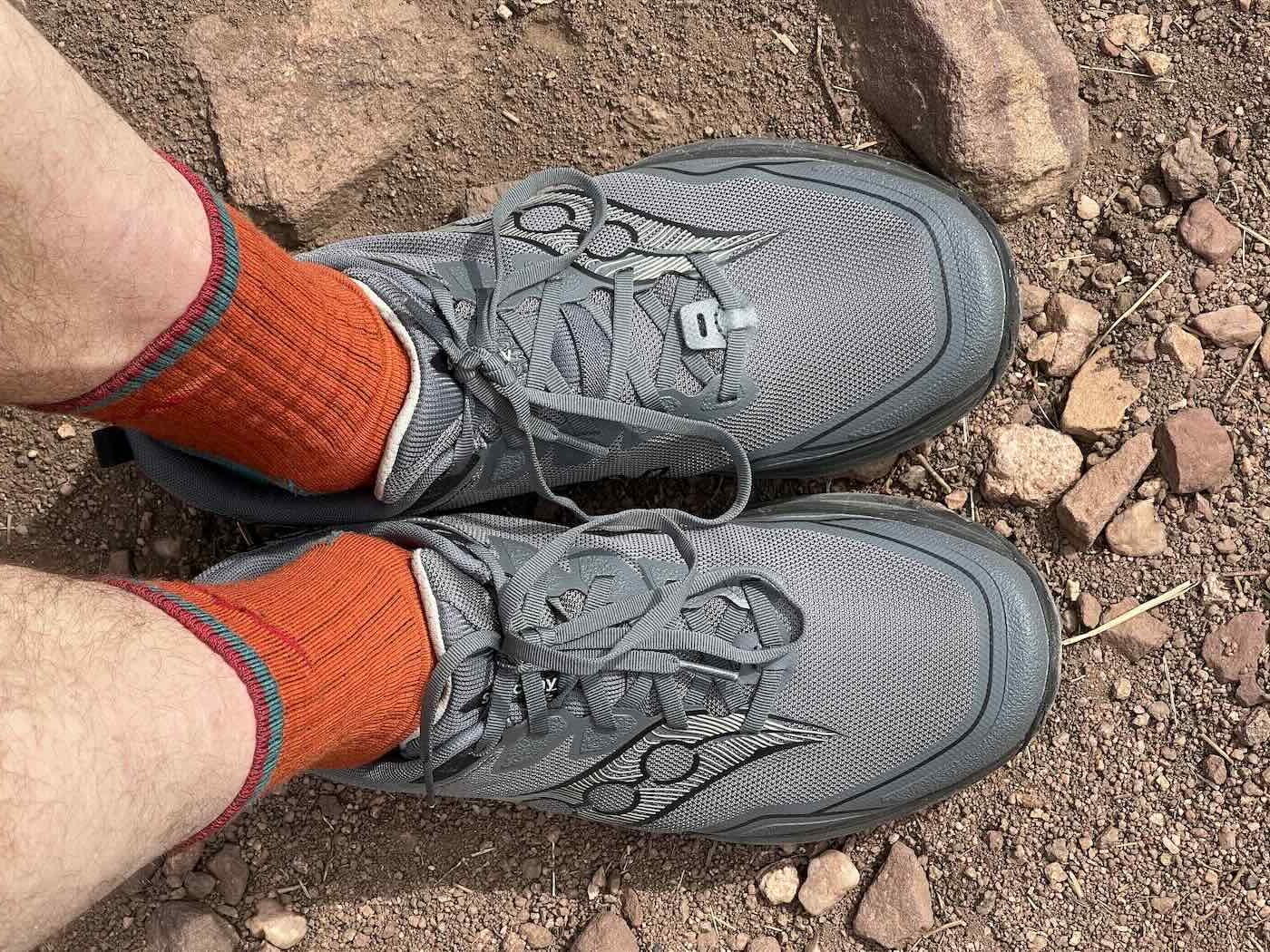

Each year, I test and review 4-5 new pairs of trail running shoes. These are the shoes I pick and use to hit my annual goal of 1000+ miles hiking and running the trails in Colorado.
Currently, my #1 trail running shoe for hiking (and running) is the Saucony Peregrine 16.
The Peregrine 15 and the new Peregrine 16 provide an elusive combination of long-distance comfort, soft and supportive cushioning, excellent foot protection, and reliable traction and grip.
For Spring and Summer 2026, I rate the Saucony Peregrine as the best trail running shoe for hikers. They outperform these popular alternatives: Hoka Speedgoat, Brooks Cascadia, La Sportiva Prodigio.
Quick overview
- $150 is best value vs the competition ($170+ for La Sportiva Prodigio 2s, $160 for Hoka Speedgoat 7s)
- Best for: rugged trail hiking, technical terrain, mountain terrain
- Not ideal for: road or pavement hikers and runners
- Versatile: Available in standard, wide fit, Gore-tex waterproof models
- Comfort: 10/10 (Soft supportive midsole cushion is a dream for 20+ miles)
- Traction: 9/10 (New Vibram Megagrip is an upgrade so far)
- Durability: 9/10 Zero wear and tear after 75+ miles in new Peregrine 16s; Peregrine 15s lasted 400+ miles
- Overall: one of the best all-around trail runners for hikers
Saucony Peregrine test history
For two year, this trail runner has been my number one for hiking and running. Here is the mileage statistics that guide this review.
- 1000+ total miles in Saucony 14/15/16s
- Testing new Saucony Peregrine 16s – Completed 60+ miles running and hiking (March 2026)
- Tested two pairs of Saucony Peregrine 15s for 650+ miles hiking and running; 400 miles first pair, 250+ miles second pair
- First tested the Saucony Peregrine 14s for 300+ miles of hiking
If you hike and run on rugged trails or challenging technical mountain terrain, the Saucony Peregrine trail running shoe is an excellent choice.
Daily updates: Hiking and running in my new Saucony Peregrine 16s
It is March 20th, 2026. After, seven trail runs and two hikes, and a total 75+ miles, I have a really good sense of the new Saucony Peregrine 16s trail running shoes. I have tested them doing local summits of Bear Peak and Green Mountain, and all the local trails here in Boulder Colorado. Temperatures have fallen in the range of 40-70F.
This week, I did extensive miles in new conditions – mud, hard-packed snow, and some icy conditions all of which can be challenging. I was most interested in how the Peregrine 16s would perform in the mud since I had only experienced dry dirt. What I noticed and appreciated was that the mud did not gum up in the lug treads. Also, I did not experience any slipping during long stretches of mud. Very pleased. Hard-packed snow was also easily navigated as were some icy sections of the trail.
In conclusion, I rate the grip and traction exceptional for dry dirt, mud, loose snow, hard-packed snow to dry ice.
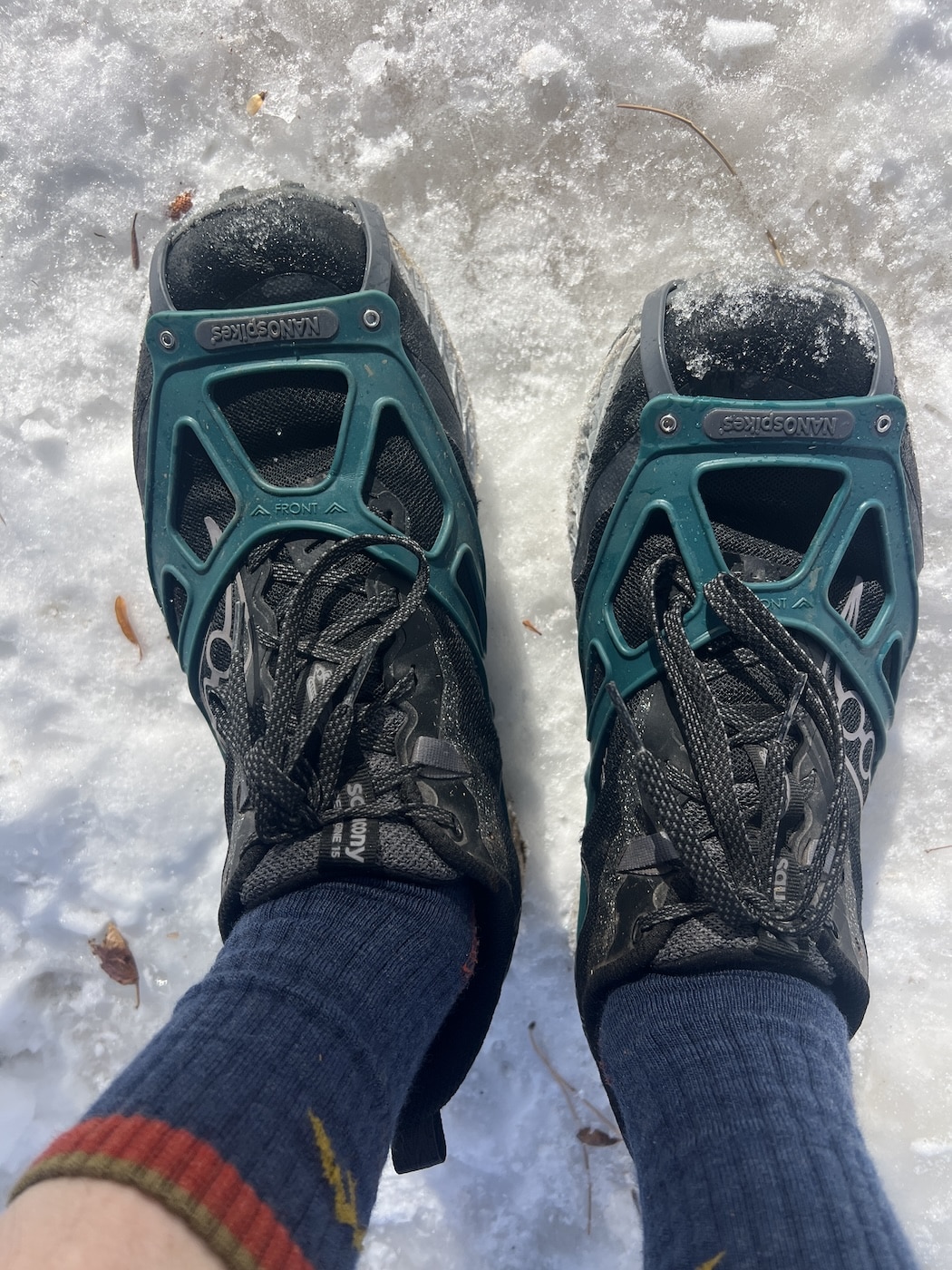
The only conditions that may pose a risk are wet icy conditions – but I definitely would wear my microspikes or nanospikes for any extensive winter conditions.
Key updates and notable changes – Peregrine 16 vs the Peregrine 15:
- Increased underfoot and toe protection
- Improved grip and traction with new Vibram Megagrip outsole and updated lug tread shapes and pattern
- Pure comfort for 10+ mile outings with soft supportive midsole cushioning
- New upper material is more durable and breathability is good
What Saucony says about the new Peregrine 16
Here is a summary of how Saucony positions these shoes:
Built for rough trails and unpredictable conditions, the Peregrine 16 delivers locked-in traction and a cushioned, protected ride. Vibram Megagrip bites confidently on wet rock, loose dirt, and technical terrain, while updated PWRRUN foam adds smoother comfort and underfoot protection mile after mile. It’s the trail shoe that lets you run naturally—fast, free, and ready for whatever the route throws at you.
Price: $150
Key specifications: 4mm heel-to-toe drop, 32mm heel stack height, 28mm forefoot stack height, 1 lb. 3 oz. weight (pair), rock plate, d-ring for gaiters
Where to buy: Saucony website | REI
Why I hike in the Saucony Peregrine 14s/15s/16s
Over the last three years, I have covered 3000+ miles on the trails. During this time, I have tested eleven different models of trail running shoes by top brands: Hoka, Salomon, Brooks, La Sportiva, and Saucony.
Finding a shoe that is comfortable, protective, and durable has been the biggest challenge. The Peregrine 16s and 15s give me this crucial combination of top must-have qualities. This is why it is the best trail running shoes for hiking, and more specifically here in the Colorado Rocky Mountains.
The Hoka Speedgoat felt comfortable for 150-200 miles, but the lug treads wore out quickly due to their shape. The Brooks Cascadia was durable and lasted 350+ miles, but the midsole was too firm and lacked cushioning and felt uncomfortable after 5 miles. I found the La Sportiva Prodigio to be more comfortable than expected, but it lacked durability with 3mm lug treads and a minimal toe area.
This is how the Saucony Peregrine 16 wins
- Soft yet supportive cushioning (not firm) for long distance comfort
- Underfoot (rock plate) and toe protection
- Durable uppers, traction and lug treads (conquers rough and rocky terrain)
- Low heel-to-toe drop and total stack (increases stability, takes pressure off forefoot)
- Breathable mesh upper (perfect for warm/dry climates)
- Wide fit model (though available in standard width)
Why the Saucony Peregrine 16s are the best trail running shoe for hiking in 2026
This shoe rates very high across all desirable features and the benefits delivered.
It is remarkable that Saucony has met so many needs for hikers and runners with this one shoe compared to the competition.
These are the top reasons why the Saucony Peregrine wins:
- Cushioning (soft and supportive) and comfort for high mileage
- Traction (lug treads are grippy and long-lasting – now made by Vibram)
- Foot protection (rock guard)
- Breathability (great in hot dry climates)
- Durability (lasts 350+ miles; and probably longer – but I like to replace after 300 miles)
- Connecting gaiters (keep snow, water, mud, debris out)
- Versatility (standard and wide fits, waterproof gore-tex option)
- Value ($20+ less vs top competitors)
Who should buy the Saucony Peregrine; why, and for what conditions?
This shoe meets the needs of a wide variety of hikers and trail runners. The Saucony Peregrine 16 is available in a standard width, a wide fit, and a waterproof gore-tex version. It makes it a versatile trail runner for hiking.
The Peregrine trail running shoes is for hikers and trail runners that:
- Hike or run long distances – soft yet supportive cushion in midsole, “like walking on clouds”, super comfortable!
- Hike or run over rugged or rocky terrain – durable tread with long-lasting grip
- Require foot and toe protection – rock guard that doesn’t sacrifice feel for the trail
- Have wide feet (best wide fit trail running shoe guaranteed); but also for narrow to standard width!
- Want a waterproof shoe for all of the above (wet or rainy climates)
- Prefer a lower heel stack (32mm) and minimal heel-to-toe drop (4mm)
Pros: The key benefits of the Saucony Peregrine 16s
After testing the Peregrine 15s for 750+ total miles and 150,000+ feet in elevation gain across the Rocky Mountains, these are the top benefits:
- Versatile with standard fit, wide fit, and waterproof gore-tex models
- Ultra comfort with incredible soft yet supportive PWRRUN midsole foam
- Amazing foot protection with rock guard and toe guard
- Durable upper, midsole foam, and lug treads
- Traction works in all conditions: dirt, mud, wet and dry surfaces, ice and snow
- Incredible value for the price (less than $0.40 per mile)
After wearing my new Saucony Peregrine 16s for 75+ miles (7 runs and 2 hikes), I can say these benefits also apply to the new model. The new Vibram MegaGrip outsoles of the Peregrine 16s have improved traction and foot protection that was already excellent.
Cons: Drawbacks to consider
There is very little to dislike about this trail runner. It is currently my number one shoe for hiking and running, I have owned 5 pairs to date, and will continue to buy them as my go-to mountain shoe.
This is where I think Saucony could improve:
- Offer more than one color for the wide foot model – at least the one color has been neutral (all-black, all-grey)
- Sell the wide foot model at REI – only available on the Saucony website
- Offer waterproof / gore-tex model for wide feet – how hard is it to put a waterproof liner in a shoe they already make?
When to use this trail runner
What is amazing about the Saucony Peregrine 15/16s trail running shoe is that you can get a model to use for all weather and trail conditions.
- Standard model is generally for warm or dry conditions
- GTX model is for cooler, wet, snowy, or rainy conditions
- Get the wide fit if you have wide feet – extra room makes for happy feet
Where to use this trail runner
The Saucony Peregrine 15/16 is built for rugged terrain of all types:
- Rocky mountain trails
- Rough or loose dirt
- Root filled forests
Where not to use this trail runner
As mentioned above, this shoe is designed for wild and rough conditions. Avoid these trail running shoes for:
- Asphalt, concrete and pavement – aka roads or sidewalks
- Flat, smooth ground that doesn’t require deep lug treads
How, what, where, when I tested the Saucony Peregrine trail runner
How I tested:
In total, I have tested five pairs, hiking and running 1000+ miles in every condition (snow, ice, mud, rain, wet, dry) imaginable and varied terrain (rock, loose dirt, mud, tundra, mountains, foothills, forest floor).
I have hiked or ran 300+ miles in the Peregrine 14s, 750+ miles in (two pairs of) the Peregrine 15s, and 75+ miles in my brand new Peregrine 16s.
What I tested:
So far, I tested the Peregrine 14/15/16 models in both standard and wide fit. Have not yet tested the GTX model because it isn’t available for wide feet.
Where I tested:
Mostly in Colorado: Boulder, the foothills, Indian Peaks Wilderness Area, Rocky Mountain National Park, and a variety of 13ers and 14ers.
When I tested:
I have tested the Saucony Peregrine trail runners in all seasons: Winter, Spring, Summer and Fall. I have worn the shoes in all weather and temperature conditions.
Field test data and ratings – Saucony Peregrine 16 vs 15
Let’s start with a look at my Saucony Peregrine 15s. This will give you a clear view of what to expect over time. The photos show brand new, out-of-the-box, and relatively fresh on the trails.
My size 11 men’s (wide fit) weighed 1.6 pounds out of the box. The forward/backward chevron arrow shaped lug treads are very effective and deliver amazing grip on all terrain types and weather conditions (except wet melting ice, which makes sense).
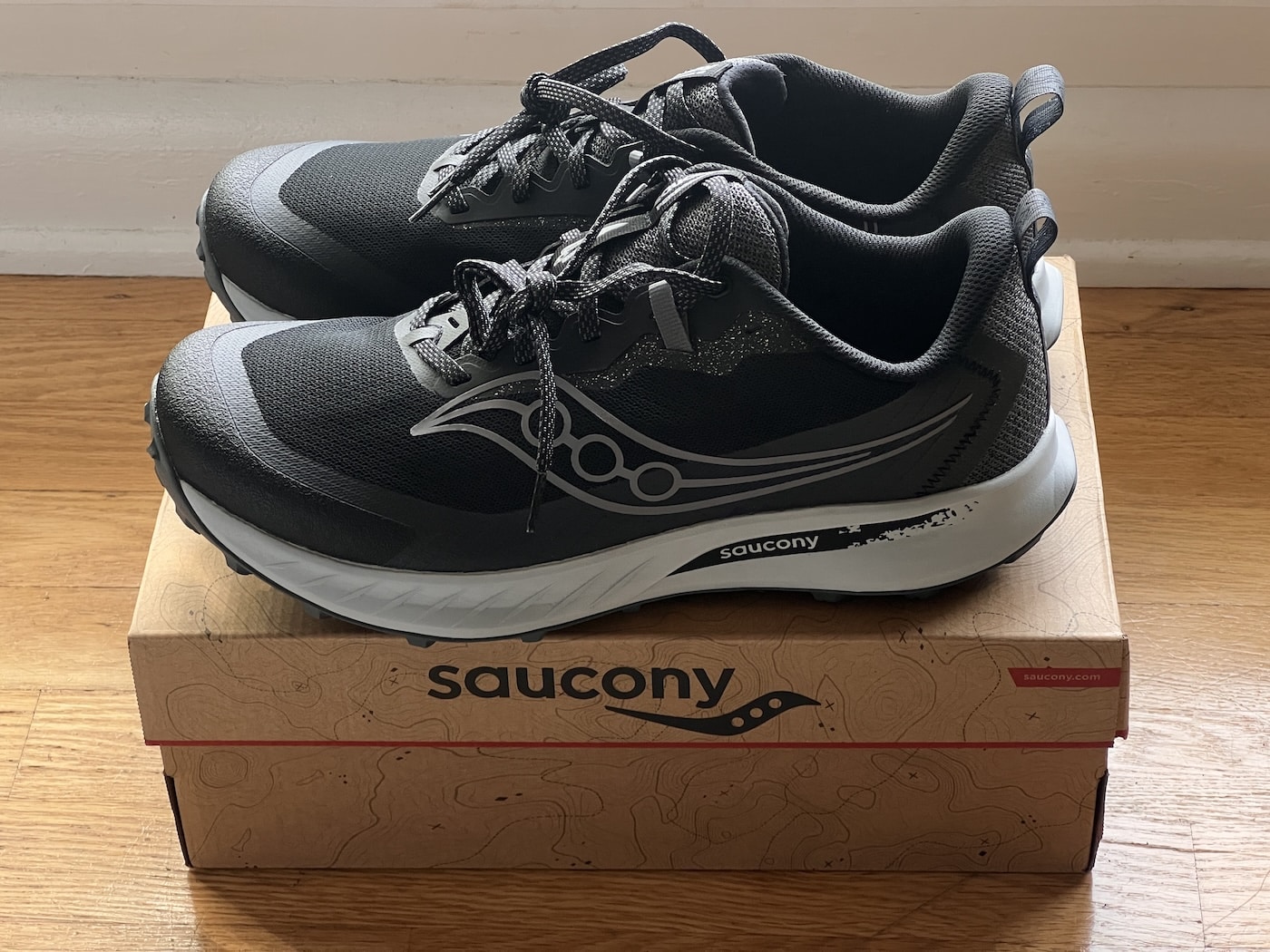
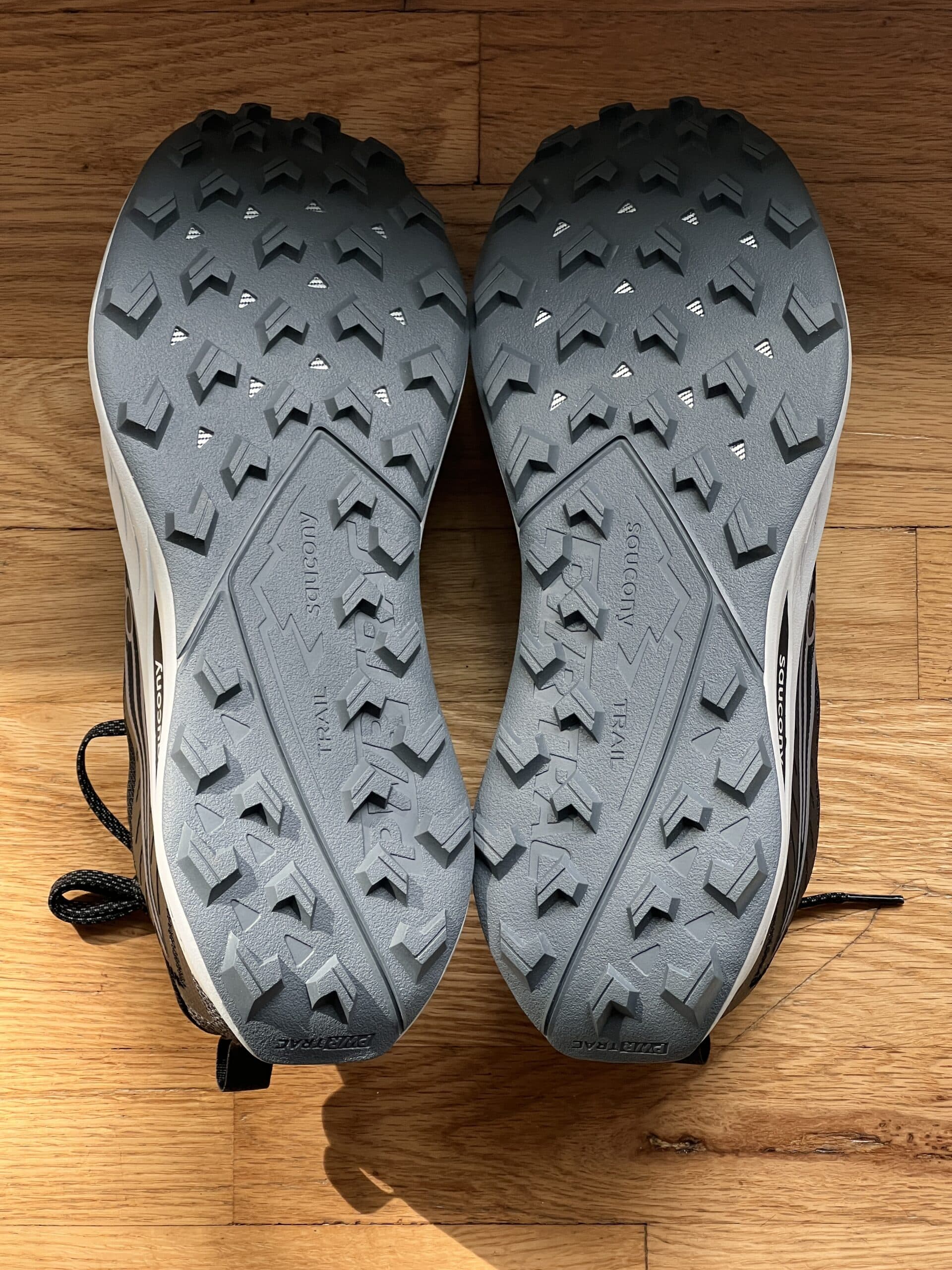


Below, is what the Peregrine 15 trail runners look like after approximately 400 miles of hiking and running. The side-by-side comparison of new vs used is an interesting contrast.


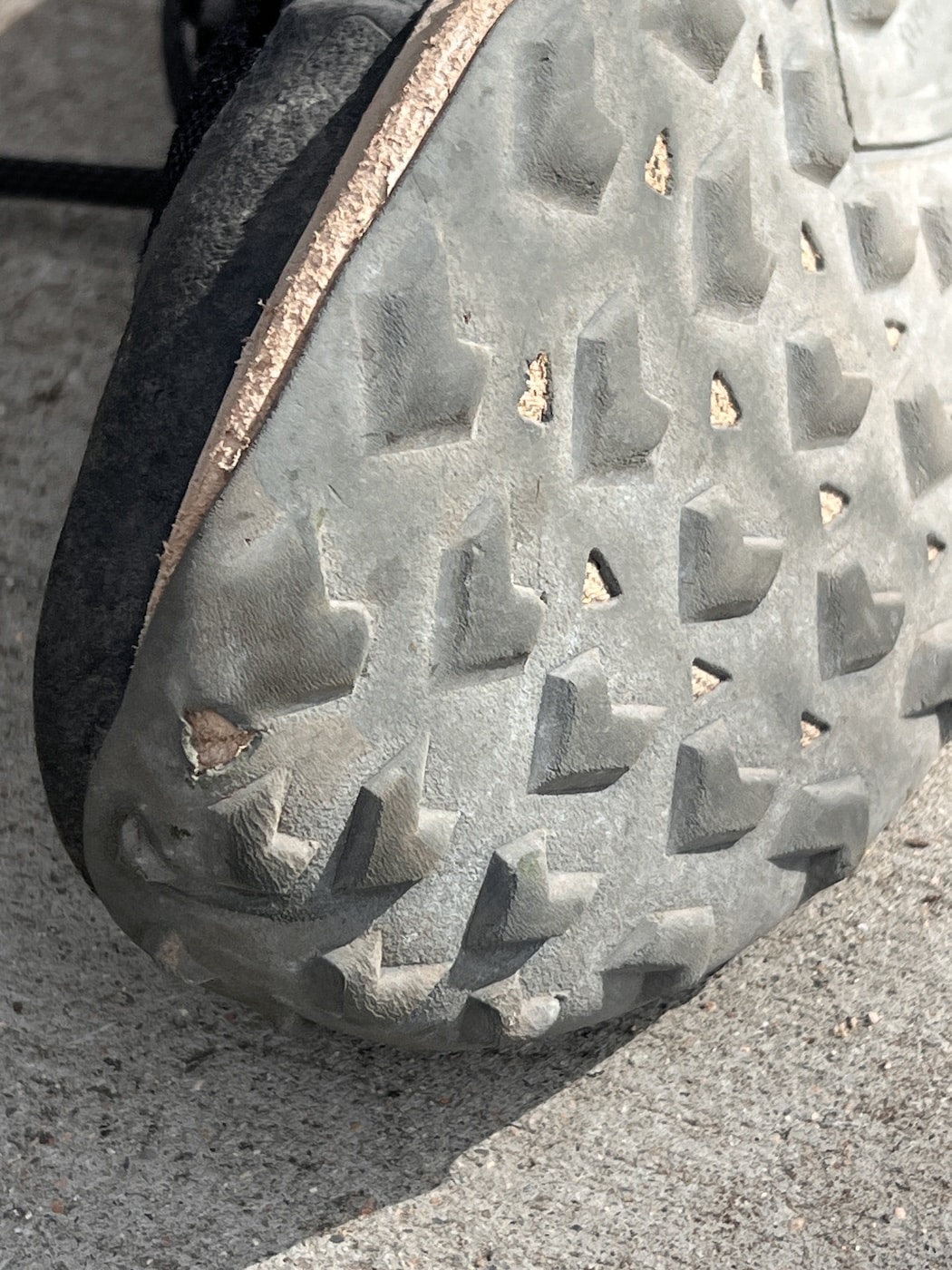

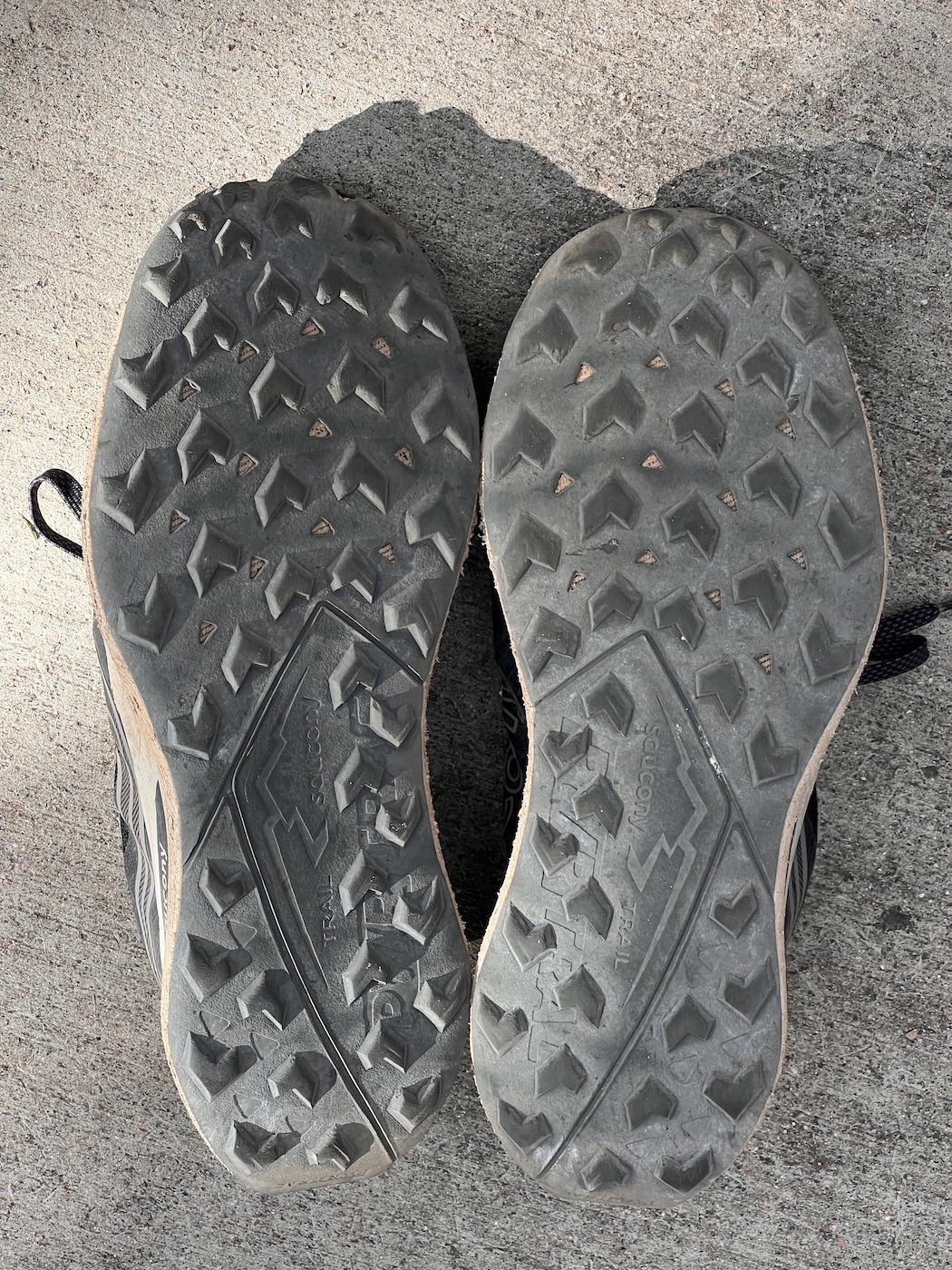

The uppers and lug treads wore mostly in the front area the shoe. The lug treads in the forefoot wore down from 5mm (brand new) to about 3.5 at worst after 400+ miles of use. The lug treads in the middle of the shoe to the back of the shoe wore down to a measurement of 4mm at worst. I rate these lug treads as very durable for the mileage.
You can see a small hole worn across the ball of my big right toe. This only occurred with my first pair that was primarily tested in very rocky, high alpine terrain. No hole developed in my second pair that I used mostly on dirt trails around Boulder. This issue of upper material durability should be resolved with the new Peregrine 16 that has a much more durable synthetic fabric that appears to be made of nylon, and more plastic like so it will not tear or wear out in the same way.
Here is a short video that gives a 360 degree view of the Saucony Peregrine 15 trail runners.
Okay, let’s take a look at the brand new Peregrine 16s! These shoes are new as of February 2026. My size 11 wide weighed in at 1.4 pounds, so slightly lighter than the Peregrine 15s. So far, I have put 75+ miles on my new Peregrine 16s. Take notice of the improved lug tread shapes and pattern from new Vibram Megagrip outsole. Grip, traction, and stability feels improved.


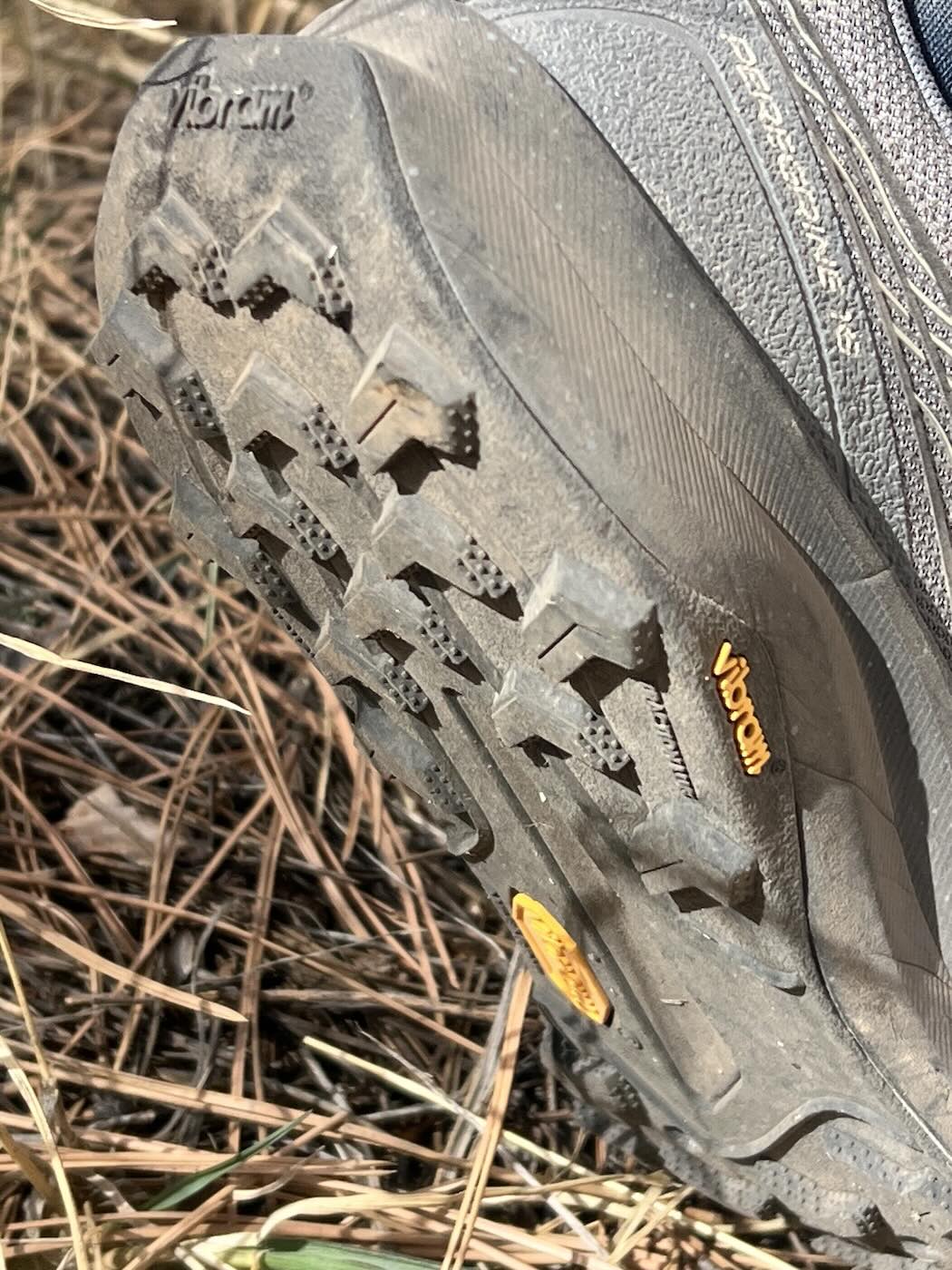
Peregrine 16s vs the Peregrine 15s:
- New Vibram Megagrip outsole delivers better grip and traction with improved lug tread shapes and pattern
- More durable (and breathable) upper -> this is a key improvement since the 15s developed a small hole in one pair that I tested
- Better under-foot and toe protection with 16s vs the 15s
- $150 (16s) vs $145 (15s) MSRP -> So, $5 more in price vs the 15s
Here is a 360 degree video of my new Saucony Peregrine 16s.
Saucony Peregrine 16s vs 15s – Test results
Saucony launched the Peregrine 16s in February 2026. To date, I have tested the new Peregrine 16s on five trail runs and two hikes for 75+ miles and 20,000 vertical feet. I love how they feel. The upgrades add to what was already amazing about the Peregrine 15s. In these test results I compare and contrast last year’s Peregrine 15s vs the new Peregrine 16s.
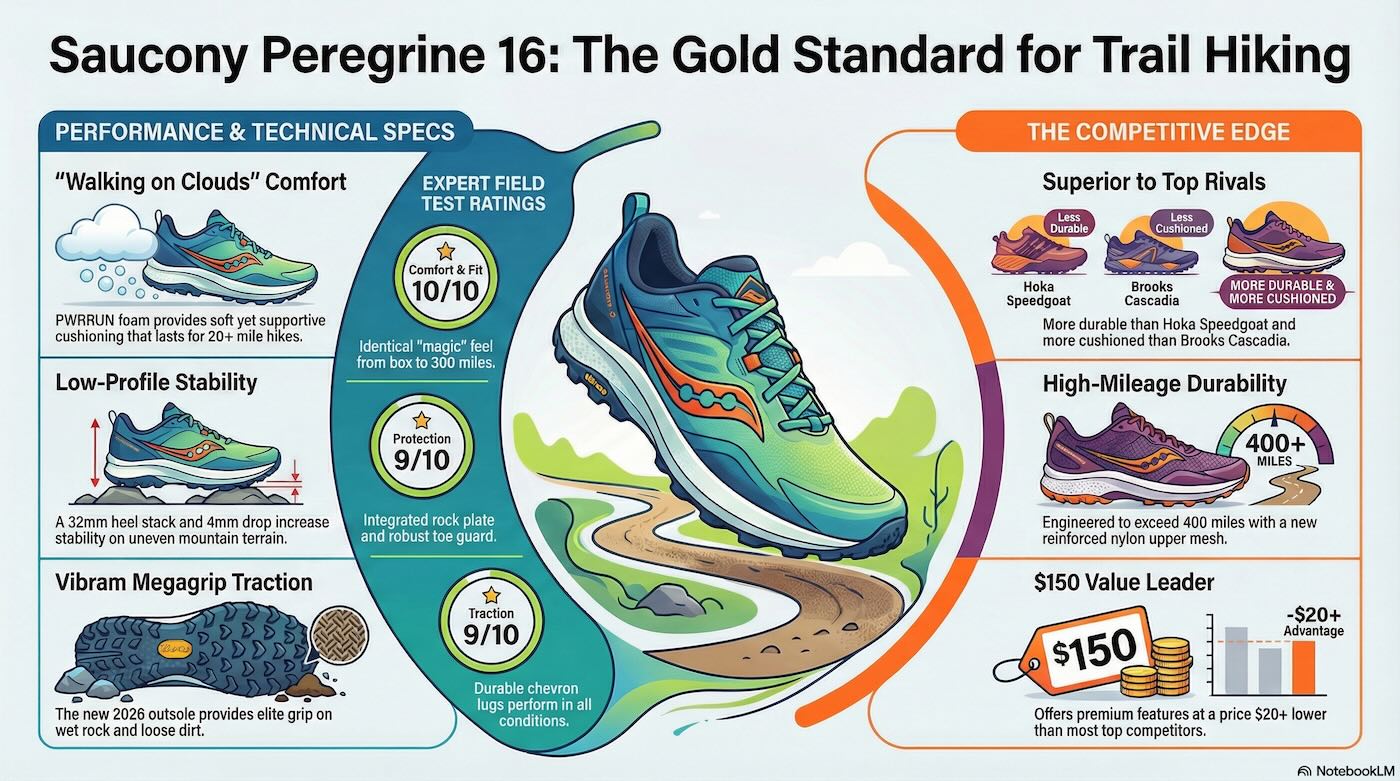
Where the Saucony Peregrine 16 Shines
The Peregrine is a trail running shoe that works in so many hiking situations. I have worn my Peregrine shoes in all conditions imaginable. I really like the grip and traction provided by the new Vibram Megagrip outsole. Despite 1mm less in lug tread height (4mm vs 5mm), the grip is improved with a better lug tread shape and pattern. The Peregrine 16s are super comfortable – the balance of cushion, support and response is unbeatable, and this feeling lasts for 300-400 miles. The rock guard and toe guards provide the best foot protection.
The Peregrine 16s is great for:
- All terrain / rugged terrain
- Rocky mountain scrambles
- Technical ascents/descents
- Loose dry dirt
- Wet dirt and mud
- Snow with microspikes and gaiters
Comfort and fit – 10/10
These are the most comfortable shoes that I have tested in my trail running shoe test journey. Your feet will not get tired or sore even when hiking as much as 10-20 miles in a day.
No other shoe that I have tested (including the Hoka Speedgoat) maintains original comfort out of the box for 300+ miles.
After 300+ miles, the Saucony Peregrine 15s felt as comfortable as they did brand new out of the box.
I have teseted the newly updated Saucony 16s for 75+ miles of hiking and running. The comfort and fit is identical to the 15s thus far. They feel like magic. Could not be more comfortable. I have worn the Peregrine 15s on hikes/runs as long as 20+ miles in the high country of Colorado and when I return my feet feel as good as when I started out.
The Saucony Peregrine 16s are made to fit all feet since they offer both a standard fit (narrow to normal widths) and a wide fit for those with wider feet.
Cushion – 9/10
The midsole is soft yet supportive. The comfort and foam response lasts up to 300 miles with ease, if not 400 miles. I love the cushion of these PWRRUN midsoles because they keep my feet comfortable and protected for long 15-20 mile hikes and runs.
Foot protection – 9/10
The rock guard in the Peregrine 15s is a dream come true. The toe guard also performs well against those accidental kicks of rocks or foot stubs.
The foot protection provided by the new Peregrine 16s is even better! Somehow, the Vibram Megagrip treads protect against the pointiest of pointy rocks. The toe guard is also a bit more robust.
Despite incredible protection, you can still feel all the details of the trail underneath your feet.
Traction – 9/10
Both the Peregrine 15s and 16s offer excellent traction on all rough surfaces including dirt, rock, mud, and in all wet or dry conditions. I have yet to feel any significant slippage other than on wet melting ice surfaces where no shoe will perform well.
The traction is durable and long lasting. I experienced insignificant wearing of 1.5mm at the very most (after 350-400+ miles) on just a few lugs in the front toe area. The arrow chevron shapes are a great design because they dig in and do not wear out. Durability was greatly improved with the 15s as Saucony deployed a newer, tougher rubber compound. The Peregrine 16s show a potential upgrade as well as they have adopted the Vibram Megagrip outsole for traction in 2026. I will update my thoughts on this at the 100 mile mark in March 2026.
At the 75+ mile mark, lug treads are not showing any extraordinary wear or rounding. Grip is excellent.
Terrain performance
- Rocky terrain: Excellent
- Loose dirt: Excellent
- Wet/damp rock: Good
- Mud: Good
- Snow: Good
Breathability – 8/10
I hike and run in a hot dry climate here in Colorado. My feet never overheat in either the Peregrine 15s or new Peregrine 16s. The new upper mesh of the Peregrine 16s seem to have improved overall breathability (more airy mesh), though I have not yet tested them in Summer temperatures. I have tested the Peregrine 16s in sunny conditions with 40-60F air temperatures, and so far they feel great.
Stability – 8/10
The Saucony Peregrine 16s have a 4mm heel to toe drop, and a lower overall heel stack height of 32mm.
The Hoka Speedgoat 7s have a 5mm heel to toe drop and a 37mm total heel stack height. The new Prodigio 2s have a 6mm heel to toe drop, and a 34mm total heel stack height – so in between the Speedgoat and the Peregrine.
The lower overall stack height of the Peregrine provides an increase in stability. It reduces the chance of rolling over on your ankle. I am not a fan of high stacked shoes. So, I love the lower drop and stack of the Peregrine.
Durability – 9/10
You can expect to get 300-400+ miles, depending on how hard you are on your shoes.
This is a durable shoe and lasts 400+ miles for most hikers. I replace my Saucony Peregrine shoes at about 300 miles. But that is a personal preference. The lug treads wore down only 1.5mm at most in the front under toes area of the Peregrine 15s. Really insignificant wear for the mileage.
The new Saucony Peregrine 16s seem to be more durable than the Peregrine 15s with the new Vibram Megagrip outsole and the new upper material.
After 75+ miles there is no wearing of the lug treads or upper material, and the midsole cushion still feels like new.
Overall score – 8.9/10
Overall, the Saucony Peregrine rates very high across all the primary features of a trail running shoe. For now, I crown the Peregrine the best trail running shoe for hiking. You can’t find a more comfortable, supportive, stable, protective, and high traction trail running shoe.
Evolution of the Saucony Peregrine trail running shoe
There have been some key upgrades between the Peregrine 14, the Peregrine 15, and the 2026 model the Peregrine 16. I love Saucony’s commitment to making a better shoe.
Peregrine 14 vs Peregrine 15
Changes to the Peregrine 15 were not super visible but were highly effective. The biggest disappointment of the Peregrine 14 was that I could not hike or run 200+ miles without shredding and tearing the rubber of the outsole. Saucony made a bad rubber choice for the 14s and so they upgraded the Peregrine 15 with a reformulated PWRTRAC outsole. The new rubber compound used was a huge improvement – I hiked and ran 400+ miles in my first pair of Saucony 15s. This was a 100% improvement and cemented my confidence in the product. The Peregrine 15 also used an upgraded PWRRUN foam in the midsole. This change provided a softer feel and better shock absorption to improve comfort and protection on uneven surfaces. Mission accomplished. The upgrades from 14 to 15 were significant in delivering exceptional value.
Peregrine 15 vs Peregrine 16
The changes from the Peregrine 15 to the Peregrine 16 are both visible and significant. For a second consecutive year, Saucony increases both value and performance. The most obvious change was again made to the outsole. The new Peregrine 16 features a Vibram Megagrip outsole with 4mm lug treads. Despite the shorter lug treads (down from 5mm in Peregrine 15), grip, traction, and foot protection has been improved without compromising feel for the trail underfoot. The shape and pattern to the lug treads is improved. The shoe digs in and is more stable on uneven ground or technical terrain. Increased PWRRUN foam has further improved comfort for long days (10-20+ miles) on the trails. The combination of the Vibram Megagrip outsole, increased midsole foam, and rock guard has improved foot protection. So far, after 75+ miles of testing the Peregrine 16, I can say I do not notice any rocks at all – notably those most pointy jabbers no longer pierce through to the foot. Another obvious change is the new type of synthetic upper material. It looks and feels more durable. It has a slightly more plastic nylon feel to it. This is a good change because a hole developed around the ball of my foot in one of my Peregrine 15s somewhere between 300-400 miles on the trail This was likely due to persistent rubbing when hiking in rocky high alpine terrain. Time will tell if this new upper fabric prevents holes from occurring again.
Best alternatives to the Saucony Peregrine 16
The new Peregrine 16 trail running shoes kill the competition. I have tested several iterations of the Hoka Speedgoat and the Brooks Cascadia trail running shoes, but neither performed as well as the Saucony Peregrine shoes. I have also tested the La Sportiva Prodigio, and I am starting to test the Prodigio 2s in parallel with the Peregrine 16s.
Hoka Speedgoat vs Peregrine 16
I found the Hoka Speedgoat 4s and 5s to be just as comfortable out of the box compared to the Peregrine 15 and 16s. However, the lug treads and midsole cushioning failed after just 150 miles of use and started to feel flat. For the price, that disappointed me and I didn’t get another pair due to the lack of durability. The shape of the lug treads rounded off quickly and the traction was simply not dependable. I will test the Hoka Speedgoat 7s in Spring 2026 to see if they have improved vs previous versions. I rate the Speedgoats a 7/10.
Brooks Cascadia vs Peregrine 16
I have tested the Brooks Cascadia 17s and 18s. It may be the most durable trail running shoe tested. I have hiked 500+ miles combined on two pairs of Brooks Cascadia 18s, one wide fit and the other the gore-tex model. I have found that the Cascadia’s become uncomfortable on long hikes greater than 8 miles because the midsole cushioning is much firmer and stiffer compared to the Peregrine 15 and 16s. The Brooks Cascadia are a versatile multi-purpose trail running shoe – you can get standard width, wide width, and a gore-tex model. The lug treads are long lasting and durable. The traction performs well in all weather conditions and terrain just like the Peregrine 16s. If you prefer a firm cushion, they may work for you. I rate the Brooks Cascadia an 8/10.
La Sportiva Prodigio 2 vs Peregrine 16
Right now, I am testing the Saucony Peregrine 16s vs the new La Sportiva Prodigio 2s.
I loved everything about the original La Sportiva Prodigio shoes except the shorter 3mm lug treads, and the toe box area that was quite minimal and not very durable, thus showing wear and tear after only 250 miles. But the soft cushion and responsive midsole felt great.
The Prodigio 2s are very different compared to both the original Prodigio, and the Peregrine 15 and 16s.
My first sense is that the Prodigio 2s serve a different and more specialized purpose – that being a trail running shoe for very rocky and technical terrain. The Prodigio 2s feel more like a hybrid of hiking shoes and trail running shoes due to the higher stack, stiffer midsole, and increased foot protection. The new Prodigio 2s are far more robust, stiffer, and more protective (new rock guard and tougher toe area) than the original La Sportiva Prodigio’s that were lightweight, flexible, and had much softer yet responsive cushioning. La Sportiva Prodigio 2 rating TBD.
